
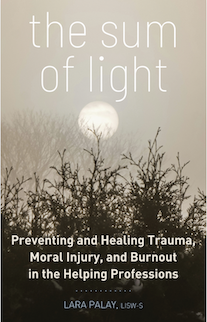
The Sum of Light: Preventing and Healing Trauma, Moral Injury and Burnout in the Helping Professions
by Lara Palay, LISW-S
Find it on NADD or on Amazon, paperback or Kindle.
From the forward to The Sum of Light
by Bruce Davis, Ph.D.
Lara Palay is an expert in therapeutic services for people with intellectual and developmental disabilities. As active members of the NADD organization and collaborators on training projects, I’ve had the privilege of getting to know her and her work. What has struck me most is the rare combination of depth and practicality that defines her approach. She moves seamlessly from the intricacies of brain science and historical theory to everyday strategies that benefit her readers and colleagues alike.
With The Sum of Light, Lara has created a timely and deeply needed book for helping professionals. And who better to offer this perspective than a helping professional herself? She brings years of experience to the table, developing strategies that are both evidence-based and introspective. Her writing merges research and reflection beautifully, offering a guide that is both intellectually rich and emotionally resonant.
This book is filled with examples that make the concepts Lara discusses tangible and applicable to our daily work. Throughout, she connects our need for healing to the shared experience of the COVID-19 pandemic. Her insights are both timely and timeless. What makes this book truly special is Lara’s masterful blending of science and soul. She draws from neuroscience, historical accounts of meditation, and age-old practices, translating them into practical strategies that align with how the brain works. She explains how to stimulate oxytocin, balance cortisol, and tolerate uncomfortable emotions—skills we often teach our clients, but rarely apply to ourselves.
What strikes me most in Lara’s writing is her honesty and validation of the inner experience of the practitioner. She openly shares moments when her motivation has flagged or when she’s fallen short of being the perfect therapist. Many practitioners feel alone in these struggles, believing they are uniquely failing. Lara’s candor gives readers permission to acknowledge these feelings—and shows that doing so is a key step toward managing them and remaining both effective and human. She offers a clear and compassionate explanation of empathetic distress—feeling the emotional impact of others’ trauma—and moral injury, which arises when we act against our values to meet external demands. Lara describes a middle ground: compassionate empathy. This stance allows us to maintain the values that brought us to our work while also preserving our sense of self. In other words, we can hold lofty ideals and still accept the reality that we can’t fix everything. And we can still be successful helpers.
Lara also emphasizes the importance of understanding our shadow—the parts of ourselves that don’t always live up to our values but are still part of who we are. Drawing from Jungian theory, she describes the shadow as the unconscious, underdeveloped aspects of the self that we often try to suppress. Rather than banishing these parts, Lara encourages us to acknowledge them. Her metaphor of the “wolf in the basement” is a powerful reminder that healing requires us to know and respect all parts of ourselves, even those we find uncomfortable. This is not just psychological insight—it’s a call to wholeness. The final chapters of this book are especially meaningful. Lara gently guides us toward self-forgiveness, helping us release the burden of perfectionism. She reminds us that healing is not about becoming flawless, but about reconnecting with our values, our bodies, and our communities. For me, these chapters offered clarity and comfort—and answered questions I had carried throughout the book. That resolution is best left for Lara to deliver, and I won’t spoil it here. But I will say: It’s worth the wait.
So, as a reader, I encourage you to take your time with The Sum of Light. Much of what Lara offers is meant to be absorbed and experienced, not just learned. Allow yourself to be renewed in a spirit that acknowledges your limitations while affirming that recovery is possible. I am deeply grateful to Lara—and to this book—for reminding me that I, and the people I serve, can be redeemed.